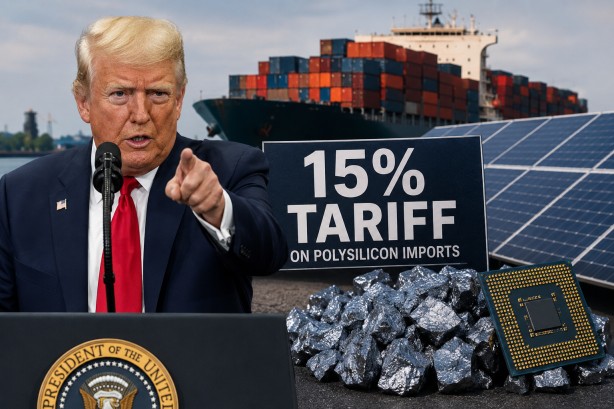
President Donald Trump has announced a new 15% tariff on imported products made with polysilicon, a crucial material for the semiconductor and solar panel industries. This tariff is set to be implemented on December 4 and is designed to bolster domestic production while decreasing reliance on imports from China, the world’s leading producer of polysilicon.
Polysilicon, an ultra-pure form of silicon, is essential in the manufacturing of semiconductors that drive artificial intelligence systems and data centers, as well as solar cells and panels. The new tariff measures also establish minimum import prices: $21 per kilogram for polysilicon, $100 per kilogram for polysilicon ingots and wafers, $0.22 per watt for solar cells, and $0.38 per watt for solar modules and panels. The U.S. administration asserts that these steps are necessary to ensure the commercial viability of domestic polysilicon production and to reinforce critical supply chains connected to economic and national security.
China has criticized the U.S. decision, accusing it of exploiting national security concerns to limit Chinese businesses and cautioning that this form of protectionism could potentially disrupt trade relations between the two nations. Despite these tensions, the U.S. is moving forward with its plan, which also includes potential government incentives for companies that invest in domestic polysilicon and related manufacturing facilities.
The United States currently hosts two major polysilicon production sites, operated by Hemlock Semiconductor in Michigan and Wacker Chemie in Tennessee. Meanwhile, China continues to experience robust growth in its export sectors, especially in electronics, artificial intelligence-related products, and other high-value manufacturing industries. As such, the new tariff reflects broader economic strategies and geopolitical considerations in the ongoing trade dynamics between the U.S. and China.